Start planning for your next tour safari by filling and submitting the form below with your tour preferences so that we can get everything ready for you in advance.
Duration: 5–8 days days
Location: Kajiado
Group Size: 1+
Tour Type: Adventure
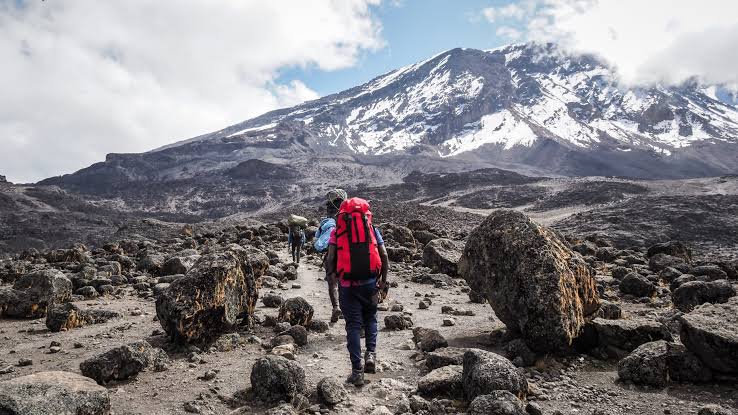
Mount Kilimanjaro rises to 5,895 metres, the highest peak in Africa and the tallest free-standing mountain in the world. It requires no technical climbing skill. What it requires is time, patience with altitude, and logistics that hold together across an international border. And the climb itself is simple in structure — you walk up slowly, you sleep, you walk up slowly again. The friction is everything surrounding it:
- Tanzanian park permits, which must be arranged before you arrive.
- A licensed operator with guides who monitor oxygen saturation properly and will turn a climber around when they should.
- Border crossing or flights, transfers, and accommodation on both sides of the climb.
- Route selection, which is the single biggest factor in whether you reach Uhuru Peak or stop short.
Organise all of that yourself from Nairobi and the expedition starts weeks before the trailhead. Hand it to us and it stays a climb.
Chariot Safaris coordinates complete Mount Kilimanjaro expeditions from Nairobi. We handle the movement, the border, the accommodation, and the partner coordination, working only with Tanzanian operators licensed by Kilimanjaro National Park. You pick your route and your dates. We take care of the rest.
Kilimanjaro passes through five distinct zones on the way up:
Level 1 — Cultivation Zone, 800–1,800 m. Villages and farmland on the lower slopes.
Level 2 — Rainforest Zone, 1,800–2,800 m. Dense forest, monkeys and diverse birdlife.
Level 3 — Heather and Moorland, 2,800–4,000 m. Giant lobelias and noticeably cooler temperatures.
Level 4 — Alpine Desert, 4,000–5,000 m. Rocky terrain. Thin air begins to affect climbers.
Level 5 — Arctic Summit Zone, above 5,000 m. Snow, glaciers and very low oxygen.
The climb runs through registration at the park gate, the rainforest trek, moorland camps, alpine desert camps, and base camp at Barafu or Kibo Hut. From there it’s a midnight summit push, past Stella Point on the Machame and Lemosho routes, to Uhuru Peak at 5,895 metres — then the descent.
Difficulty: ★★★★☆ (4 out of 5). The defining challenge is altitude, not technical climbing skill. Fitness helps. Acclimatisation decides.
Package Pricing Breakdown
Kilimanjaro is priced by route rather than group size, because the number of days on the mountain drives almost all of the cost. Longer routes cost more and summit more reliably.
| Route | Days | Difficulty | Cost per person (USD) | Best for |
|---|---|---|---|---|
| Marangu | 5–6 | Moderate | 1,500 – 2,200 | Limited time, hut accommodation |
| Machame | 6–7 | Moderate–Hard | 1,800 – 2,800 | Scenery and strong acclimatisation |
| Rongai | 6–7 | Moderate | 1,900 – 3,000 | Quieter trails, drier northern approach |
| Lemosho | 7–8 | Moderate | 2,200 – 3,500 | Highest summit success rate |
Route costs cover park fees, guides, porters, cooks, mountain accommodation and meals on the climb. Transport from Nairobi, pre- and post-climb hotels, and gear hire are quoted separately. Group discounts apply from four climbers upward. For a school, corporate, or institutional expedition, message us for a tailored quote.
What's Included in Your Package:
However you climb, the package covers the parts that turn an ambition into an expedition:
- Full itinerary planning and pre-departure briefing
- Cross-border coordination and border formalities support
- Airport transfers, whether you arrive by road or by air
- Kilimanjaro National Park permits and rescue fees
- Professional mountain guides through vetted Tanzanian partners
- Porter and cook arrangements
- Mountain accommodation — huts on Marangu, tents on all other routes
- All meals and drinking water on the mountain
- Accommodation before and after the climb
- 24/7 support throughout your journey
Add-ons available on request: gear hire, extra acclimatisation days, Nairobi or Arusha safari extensions, and Moshi cultural day tours.
What Your Package Does Not Include:
To keep the pricing honest, here’s what sits outside the package unless you ask for it:
- Tanzania visa fees
- International and regional flights
- Personal climbing gear — boots, summit jacket, sleeping bag, poles
- Travel and evacuation insurance (required, not optional)
- Meals and drinks off the mountain
- Tips for guides, porters and cooks (budget USD 250–350 per climber)
- Personal expenses and souvenirs
Your Itenerary Snapshot:
The summit is one point, but there are four established ways to reach it. We run all four — the right one depends on your fitness, your time, and how badly you want to stand on Uhuru Peak.
Marangu — the practical one
The only route with permanent hut accommodation, which means no tents and the most comfortable nights on the mountain. It’s also the shortest, and the shortest route acclimatises the least, which is why its summit rate sits below the longer approaches. Best for groups short on time who accept the trade-off.
Machame — the scenic one
The most popular route, and deservedly so. It climbs high and sleeps low across a varied, spectacular landscape, which acclimatises you properly. Steeper and more demanding than Marangu, with camping throughout. This is our default recommendation for fit, first-time climbers.
Rongai — the quiet one
The only approach from the north, coming up the drier side of the mountain with far fewer climbers on the trail. Gentler gradients than Machame with comparable acclimatisation. Best for groups who’d rather not share the mountain, and the strongest option during the rainy seasons.
Lemosho — the one that summits
The longest route, and the one with the highest success rate for exactly that reason. Eight days gives your body the time altitude actually demands, and the western approach crosses the most remote and beautiful terrain on the mountain. The most expensive option and the one we recommend to anyone whose priority is reaching the top.
Not sure which fits? Tell us your group’s fitness, altitude experience and available days, and we’ll recommend the route that suits you.
Your Accommodation Options:
What to Carry on Your Adventure
We handle transport, permits, guides, porters and accommodation — but your personal kit is yours, and on Kilimanjaro it matters:
- Valid passport and Tanzania visa
- Yellow fever certificate where applicable
- Travel and evacuation insurance documents
- Waterproof hiking boots, properly broken in
- Insulated summit jacket
- Thermal base layers and mid-layers
- Waterproof trousers and jacket
- Sleeping bag rated for sub-zero temperatures
- Warm gloves, beanie and neck buff
- Trekking poles
- Headlamp with spare batteries
- Sunglasses, sunscreen and lip balm
- Daypack, plus a duffel for porters
- Personal medication and a first-aid kit
- Energy snacks
Gear hire is available in Moshi if you’d rather not fly with a summit jacket and a four-season sleeping bag. Tell us in advance and we’ll arrange it.
A note on altitude: most climbers who don’t summit stop because of altitude, not fitness. Our partner guides monitor the group daily and will turn a climber around when the numbers say so. That call is not negotiable, and it is the reason we work with these operators.
What Your Tour Will Look Like:
